Signs you need a deload week: what your logbook shows

The standard answer to when you should deload comes in 2 parts: a checklist of feelings (tired, sore, unmotivated, achy joints, sleeping badly) and a calendar rule of every 4 to 8 weeks. Both are weak instruments for a lifter coaching themselves.
The overtraining literature has established exactly 1 reliable marker, and it is a sustained drop in performance. That lives in your log, not your mood. If you record load, reps and RIR per set, as the per-set log in Lift does, you already hold the 2 signals worth reading.
What are the real signs you need a deload week?
The sign that holds up is a sustained drop in your logged performance: the same lift at the same rep target and RIR, less load or fewer reps, across 2 or 3 consecutive sessions rather than a single bad day. A systematic review of overtraining in resistance exercise concluded that “no marker other than a sustained decrease in performance has been established as a reliable indicator of overtraining in resistance exercise”.
That review found 22 studies that tried to induce overreaching with resistance training. In 10 of them, performance never declined. The evidence base under the word “overtraining” is thinner than the confidence of the average signs listicle.
Soreness that won’t clear, poor sleep, achy joints, a raised resting heart rate and lost motivation are worth noting. Acting on them alone is the mistake. In a survey of 605 resistance-training athletes, 71% had experienced an unexplained performance drop, 43.8% of those slumps lasted between 1 week and 1 month, and 92.5% of maladaptation episodes came with non-training stressors attached. A flat fortnight tells you a stressor exists. It does not tell you training is the stressor.
A lot of the time the way I feel about my body doesn’t line up with the actual numbers. That’s part of why I like the numbers: they ground me, I can’t really argue with them, and how I feel is a constant conversation.
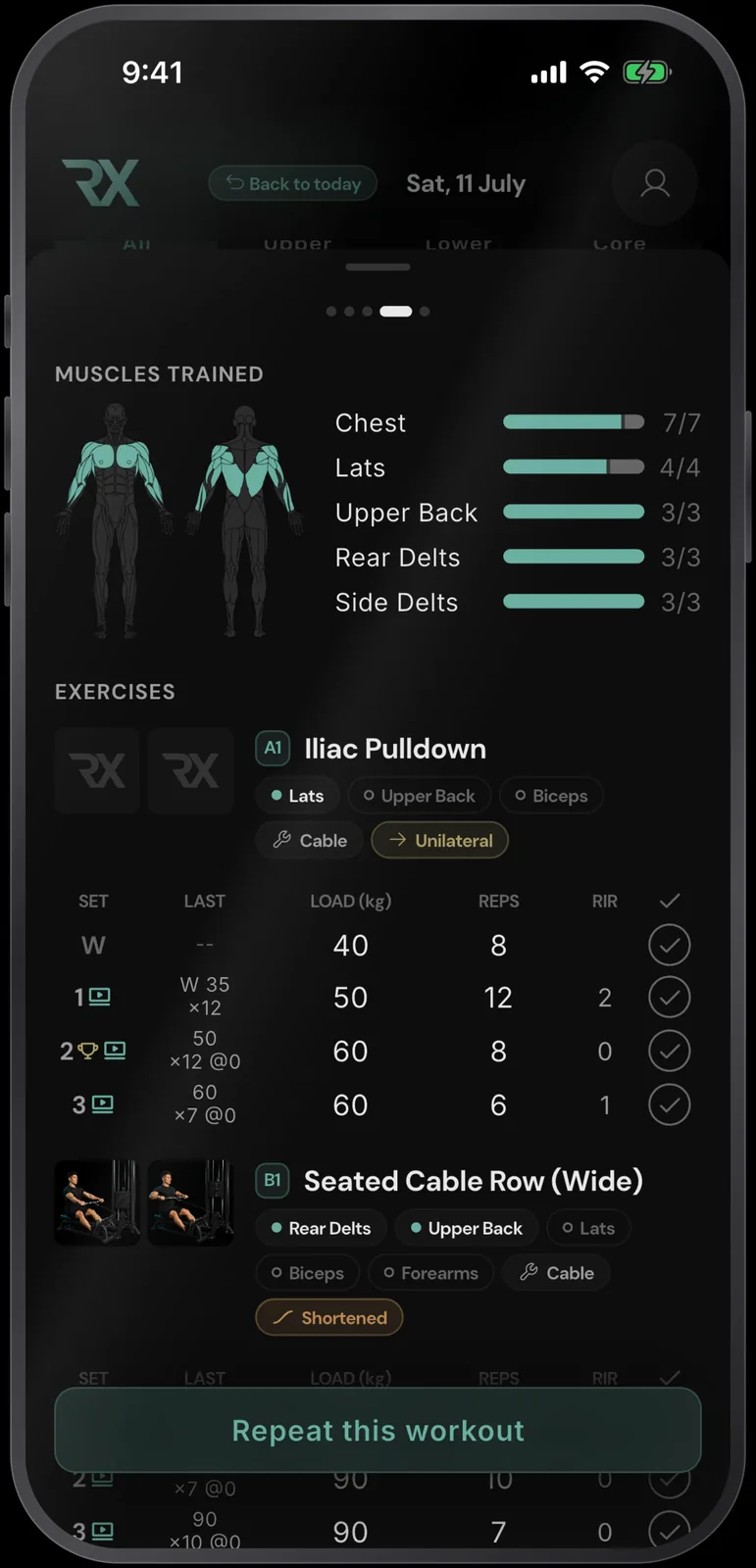
RESISTX logs load, reps and RIR for every set and keeps history per exercise, so the comparison is already there when you want to make it. The app holds the trend. The lifter makes the call.
How do you tell accumulated fatigue from a single bad session?
Compare the last 2 or 3 sessions of an anchor lift against its own trailing baseline, which is the previous 3 to 4 weeks at a matched rep target and matched RIR. Treat a single session below baseline as noise. Fatigue that justifies a deload shows up on 2 or more anchor lifts and does not clear after a rest day or two.
A worked example. Your anchor lift is a chest-supported row, 3 sets of 8 at 2 RIR. Across weeks 1 to 4 you sat at 100 kg for 8, 8, 7. Week 5 the same 2 RIR gets you 95 kg for 8, 7, 7. Week 6 it gets you 95 kg for 7, 7, 6. That is 2 sessions under baseline at matched effort on a lift you know well, which is a reason to look at your week rather than push into it.
Match on RIR, because raw load across weeks confuses going harder with getting stronger. A set of 8 at 100 kg taken to 0 RIR and a set of 8 at 100 kg at 2 RIR are different results, and a log that stores only load and reps cannot separate them.
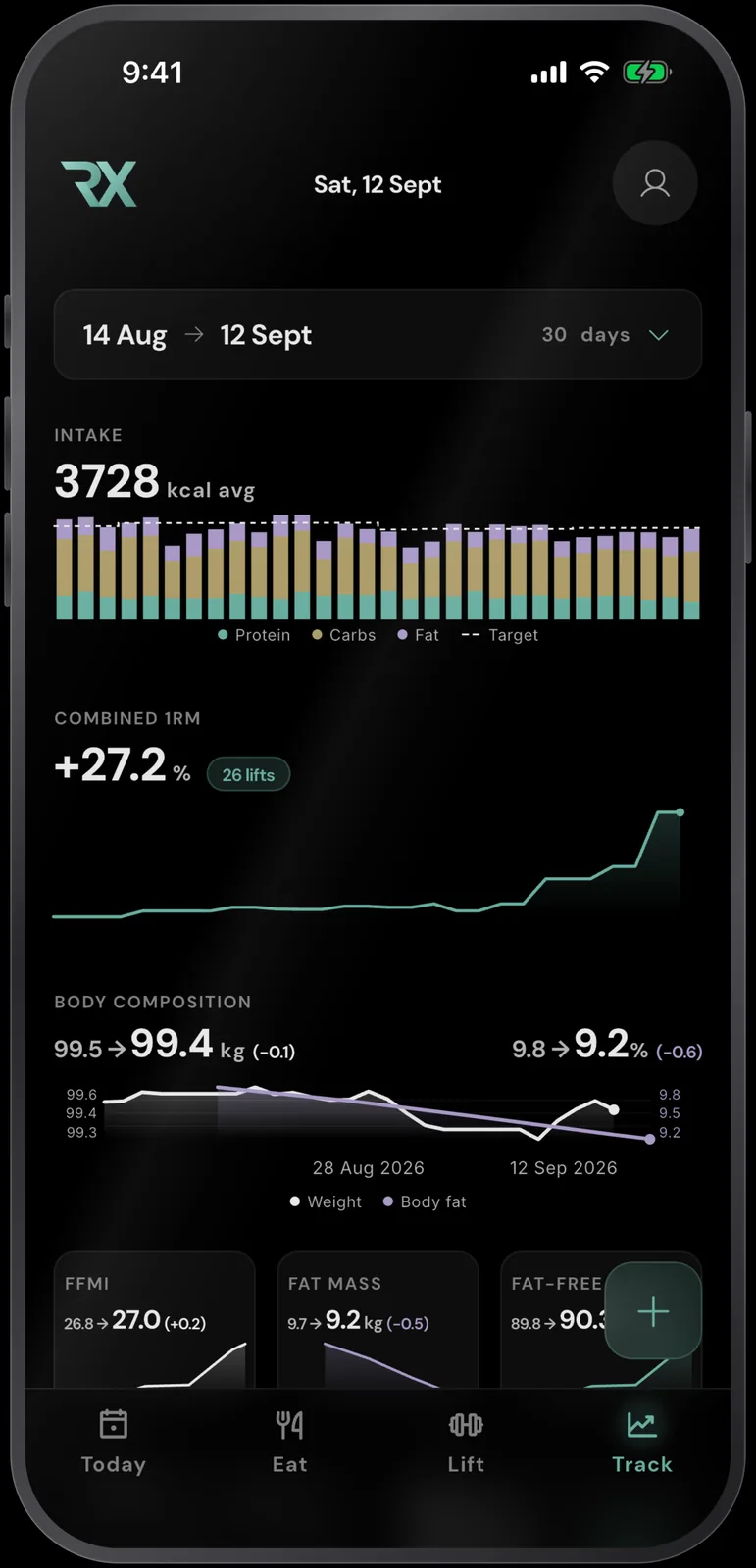
For the quick read across every lift at once, the Combined 1RM card on the Track tab is the graph to look at. It takes each lift’s estimated 1RM, expresses it as a percentage change from its first reading in the window you have selected, and averages those changes across every lift with a reading in the trailing 7 days. A line sloping down across 2 or 3 weeks while the badge still says 26 lifts is fatigue showing up across the program, not one bad day on one movement. It answers whether strength is going up or down in one glance, and the per-set log underneath it tells you why.
Expect a dip after a genuinely brutal session. In 37 trained lifters, sets taken to a 40% within-set velocity loss left force output still measurably reduced 24 hours later. A bad Thursday after a savage Tuesday is the system working.
What is RIR drift, and why does it matter more than how you feel?
RIR drift is when the same effort label buys less work: the 2 RIR set that was 8 reps at 100 kg a month ago is now 6 reps at the same load, or those 8 reps now land at 0 RIR. RIR drift sits in the gap between “my numbers are fine” and “my numbers dropped”, because the effort cost of the same output rises before the output falls.
Drift is only readable above its own noise floor, and that floor is well measured. Trained lifters predicting 1 RIR and 3 RIR on a barbell bench press at 75% 1RM were accurate to 0.65 ± 0.78 reps in absolute terms, with a slight tendency to underpredict. On less practiced work the error runs wider: 1.6 reps at a 2 RIR bench target and 4.6 reps at a 4 RIR leg press target before any practice, shrinking by 0.4 to 2.3 reps over 6 sessions.
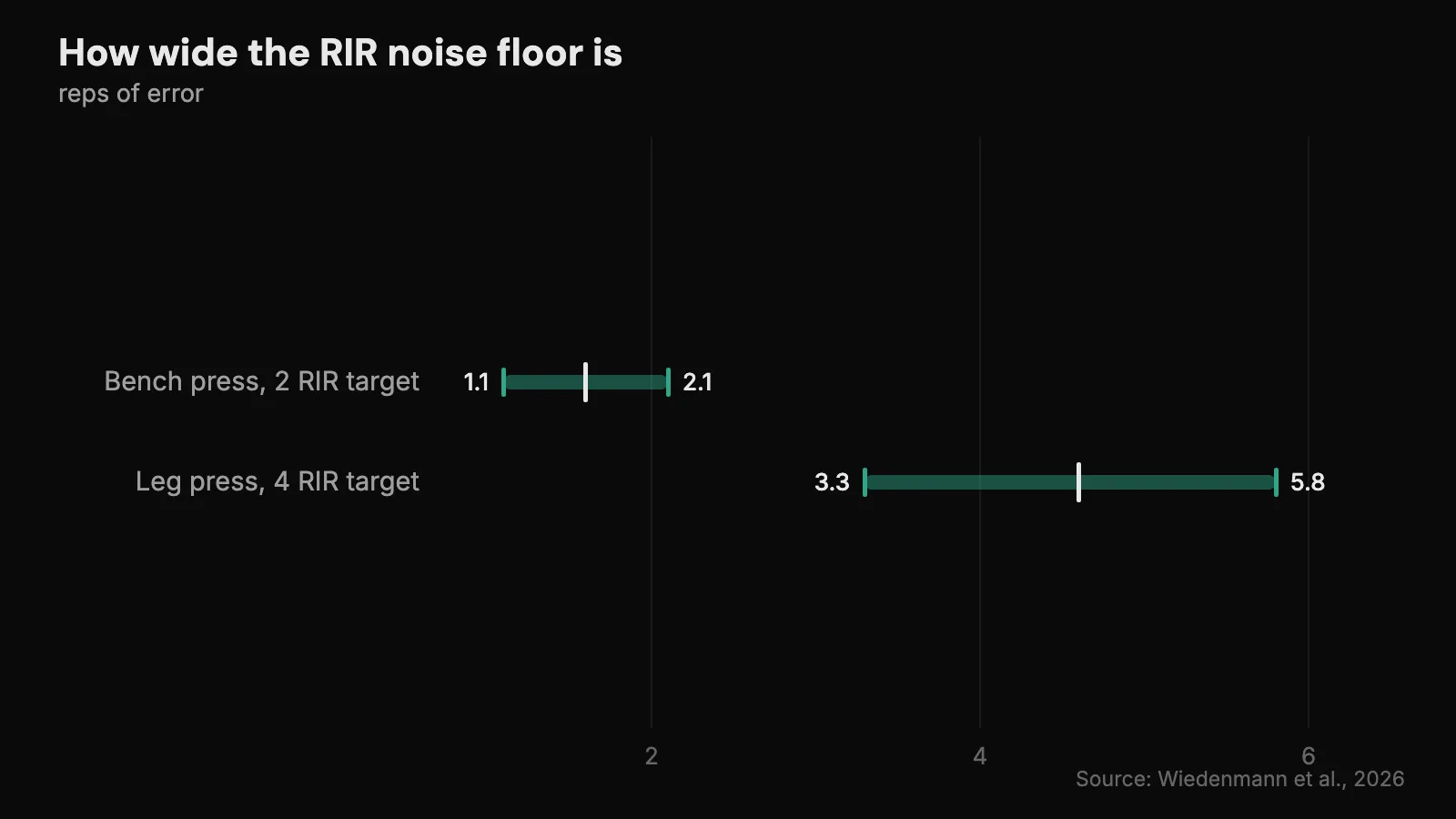
Accuracy did not track with sex, years of training or relative bench strength. Being experienced does not sharpen your calls. Reps on the specific lift do.
A 1-rep wobble is noise. A shift of 2 reps or more at the same load, sustained across sessions on a lift you take close to failure often, clears the floor. RIR estimates also get sharper the closer a set runs to failure and later in a session, so read drift from working sets and never from warm-ups. Drift is a comparison of your own proximity to failure calls over time, which only means something if the target has been consistent.
Can rep speed tell you when to deload?
Rep speed carries a real fatigue signal: every lifter has a personal relationship between bar speed and reps in reserve, and in 46 trained lifters, individual RIR-velocity curves fit better than generic ones at every load and in both testing sessions. Most self-coached lifters own no velocity device, so the usable version of rep speed is relative: does the first rep of your working set look slower on video than it did a month ago, and does the set start decelerating earlier?
RESISTX runs rep-quality video analysis from your phone camera on any exercise, machine, cable, dumbbell, barbell or Smith. It reports rep-speed falloff, cadence, rep-to-rep range-of-motion consistency, sticking points and left/right balance. It does not report bar velocity in metres per second. Nothing here replaces a velocity device, but it gives you a same-camera, same-angle comparison you can repeat weekly.
How often should you actually deload, and for how long?
Competitive strength and physique athletes report deloading for 6.4 ± 1.7 days, every 5.6 ± 2.3 weeks. The practical recommendations for those sports use pre-planned deloads every 4 to 8 weeks, with a structured duration of 5 to 7 days and a reactive deload as short as a single session.
Look at that error band. 5.6 ± 2.3 weeks spans roughly 3 to 8 weeks, which is the entire range calendar advice hands out as a rule. The same review notes the risk of non-functional overreaching from prolonged hard training without deloading is low, suggesting athletes likely do not need to deload often. Put the checkpoint in the calendar every 4 to 8 weeks. Let the logbook decide whether you take it.
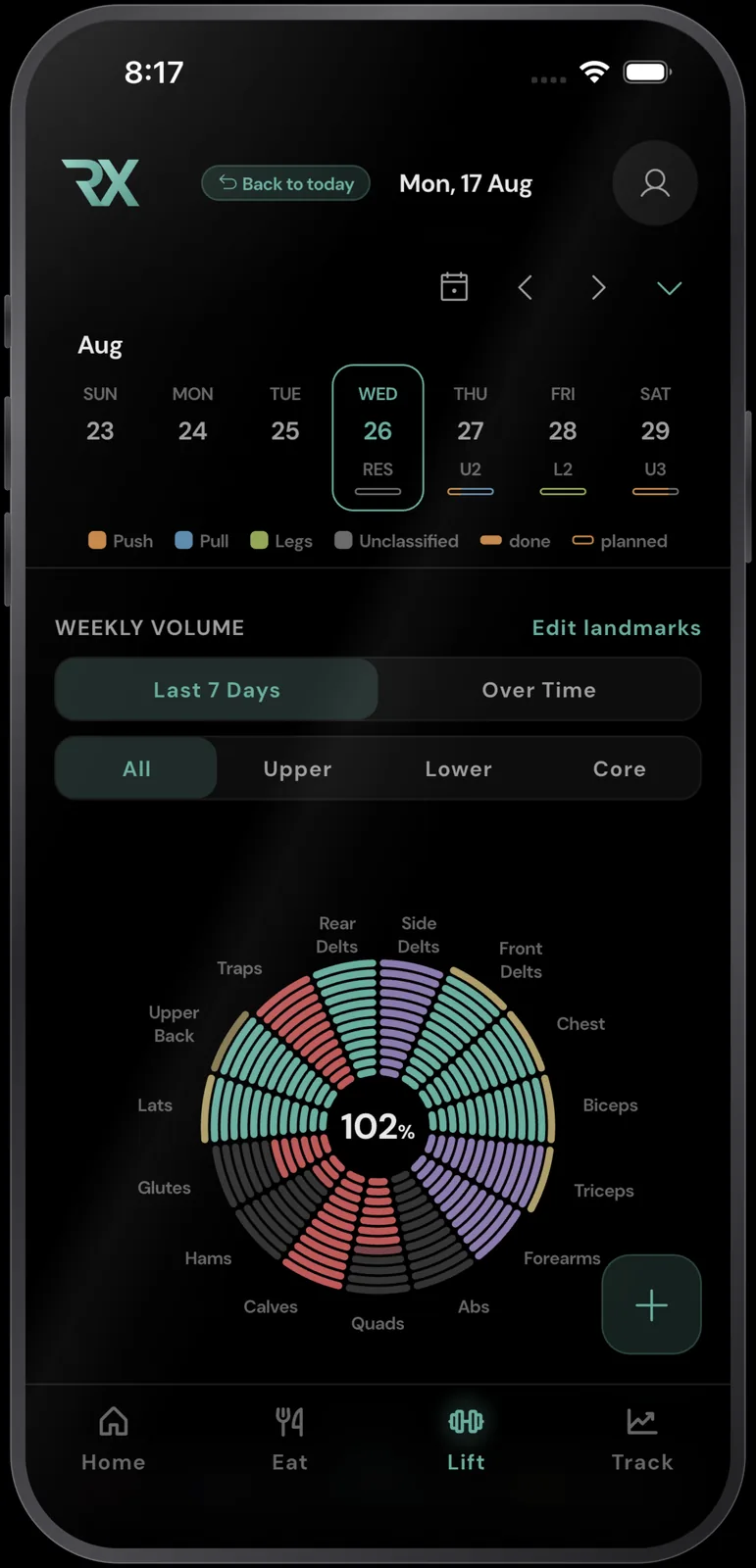
Your position in the block changes what a flat session means. RESISTX scores weekly sets per muscle against MEV, MAV and MRV zones, seeded at defaults like chest 10, 16 and 22 or quads 9, 16 and 22 effective sets per 7-day cycle, which you can override. 6 weeks parked at the top of your MRV band is a different context from week 2 at MEV.
Should you deload or just take the week off?
Deload: keep training in and cut the dose. A week of complete cessation mid-block is the single deload variant ever tested in a randomised controlled trial, and it cost lower-body strength while adding nothing to hypertrophy, power or muscular endurance.
That trial randomised 39 trained lifters, 29 men and 10 women, inside a 9-week program of about 90 weekly sets, each muscle trained twice a week. Credible intervals favoured training through: -5.1 to 42.1 Nm on isometric strength and -3.0 to 12.1 kg on squat 1RM. Both intervals cross zero, so the honest reading is that there is no reason to prefer a week off, not that a week off wrecks you.
| What changes | Typical duration | Objective | When it fits | |
|---|---|---|---|---|
| Deload | Volume cut in a step, intensity down about 10% of %1RM or effort back 1 to 3 RIR, frequency held | 5 to 7 days | Shed fatigue, arrive at the next block ready | Fatigue or a sustained performance drop mid-block |
| Training cessation | All training stops | 5 days is enough to reduce isometric bench press force with no change in lean body mass | Complete rest | Illness, injury or a performance decrement that has not resolved |
| Taper | Volume down 30 to 60%, intensity held at or above 85% 1RM | Runs into competition day | Peak on a date | Competition prep |
What should a deload week look like?
Cut volume in a step at the start of the week, sized to how deep the hole is: 25 to 45% off your previous block’s volume if you are mildly stale, 40 to 60% if performance has been sliding, 60 to 90% if you are badly beaten up. Hold your training frequency and your exercise selection, and cut intensity either by dropping about 10% of %1RM while keeping reps, or by keeping the load and stopping 1 to 3 reps further from failure.
A step, not a ramp. Surveyed athletes deload much the same way: reps and sets down, load down, effort pulled back by adding reps in reserve, frequency and exercise selection largely unchanged.
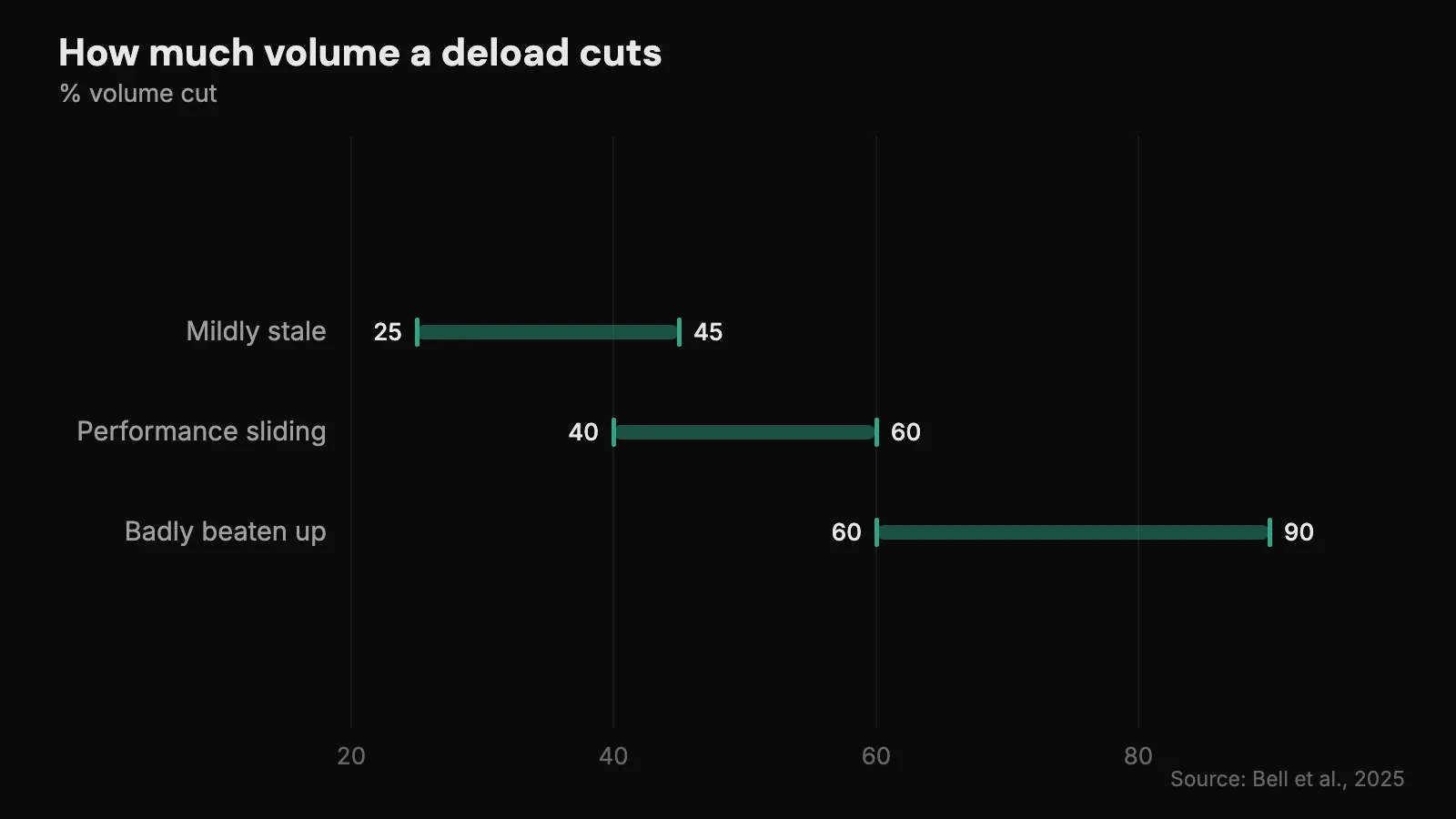
If you are cutting 40% of your volume, cut it from a number you trust. This means counting sets per muscle group per week with secondary movers at half credit rather than tallying total sets on the day.
Come back when the anchor lift at a matched rep target and matched RIR is at or above its trailing baseline. RESISTX holds the data to answer that: load, reps and RIR per set, per-exercise history, a combined estimated 1RM trend across every lift, weekly sets against your landmarks, and sleep and resting heart rate synced from Apple Health or Health Connect on the same charted timeline with phase overlays. It does not tell you when to deload. It is an instrument, and the judgment stays with you.
Pick your anchor lifts now, before you need them: an upper-body movement and a lower-body movement you have taken close to failure for months. Drift is unreadable on a lift you added 3 weeks ago.
FAQ
How long should a deload week be?
5 to 7 days for a structured deload. Athletes in strength and physique sports report 6.4 ± 1.7 days on average, with wide individual spread. A reactive deload triggered by a bad week can be shorter, down to a single session with volume and effort pulled back. Duration follows how deep the fatigue is, not the shape of your calendar week.
Will I lose muscle during a deload week?
No. A week of reduced training is far too short for meaningful atrophy. Even 5 days of complete cessation reduced isometric bench press force with no change in lean body mass, which tells you what dips first: neuromuscular and skill factors, not tissue. That gap between force and tissue is the argument for cutting the dose rather than stopping.
Is it better to deload or take the week off?
Deload. The only randomised trial of a mid-block week off, 39 trained lifters across 9 weeks, found it hurt lower-body strength relative to training through, with no benefit to hypertrophy, power or muscular endurance. Complete cessation is the right call for illness, injury or a performance decrement that has not resolved, not for ordinary accumulated fatigue.
How do I know the deload worked?
Run the trigger in reverse. Your anchor lift at a matched rep target and matched RIR should be at or above its trailing baseline in the first week back. If load at matched RIR is still under baseline after a full deload, look at sleep, energy intake and life stress: 92.5% of self-reported maladaptation episodes had non-training stressors attached.