MacroFactor vs Cronometer: what a lifter should pick

Every page-one result for MacroFactor vs Cronometer follows the same template. A feature checklist, a nutrient count, a comparison table, then the verdict: MacroFactor for macros, Cronometer for micros. That answers a question a self-coached lifter isn’t asking.
Two concessions first, because both are true. MacroFactor’s adaptive expenditure algorithm is the best of the mainstream ones. Cronometer has the deepest micronutrient coverage of any mainstream tracker. Everything below, and the rest of the nutrition tracker comparisons, starts from those two facts.
The real difference is narrower than macros against micros. It comes down to what your expenditure estimate is allowed to see, and how much logging friction you’ll actually sustain to feed it.
MacroFactor vs Cronometer: which should a lifter actually use?
Pick MacroFactor if you want calorie and macro targets that shift automatically as your metabolism changes through a bulk or a cut. Pick Cronometer if you want the deepest micronutrient picture and are happy setting your own numbers.
MacroFactor publishes an accuracy analysis of 748 users across their first 100 days, and no page-one comparison cites it. That dataset is why you should take the adaptive claim seriously. It’s also the vendor’s own, so bound it.
| MacroFactor | Cronometer | |
|---|---|---|
| Where your calorie target comes from | The expenditure model recalculates it | You set it |
| What the estimate is allowed to see | Weight trend and logged intake | No adaptive expenditure |
| Micronutrient depth | Not what it’s built around | The deepest of the mainstream trackers |
| Photo and voice logging | Yes | Yes |
Neither app sees your training or your body composition. For a lifter, that’s the third axis, and it’s where the weekly decision actually gets made.
How does an adaptive TDEE work, and when can you trust it?
An adaptive TDEE back-calculates what you burn from two things you already record: your logged intake and your smoothed weight trend. Expect 2 to 3 weeks of consistent logging before the number is worth acting on, then 1 to 2 weeks for it to register a genuine change in expenditure.
The arithmetic is an identity, not a prediction. Average intake, plus the energy equivalent of the weight you gained or lost across the window, is your expenditure for that window. A formula can’t get there. Hall and Chow name the reason: the most serious error of the 3,500 kcal rule “is its failure to account for dynamic changes in energy balance that occur during an intervention”. The steady-state response is slow. A permanent change of 10 kcal a day moves body weight about 1 lb eventually, roughly half of it inside a year and 95% inside 3 years.
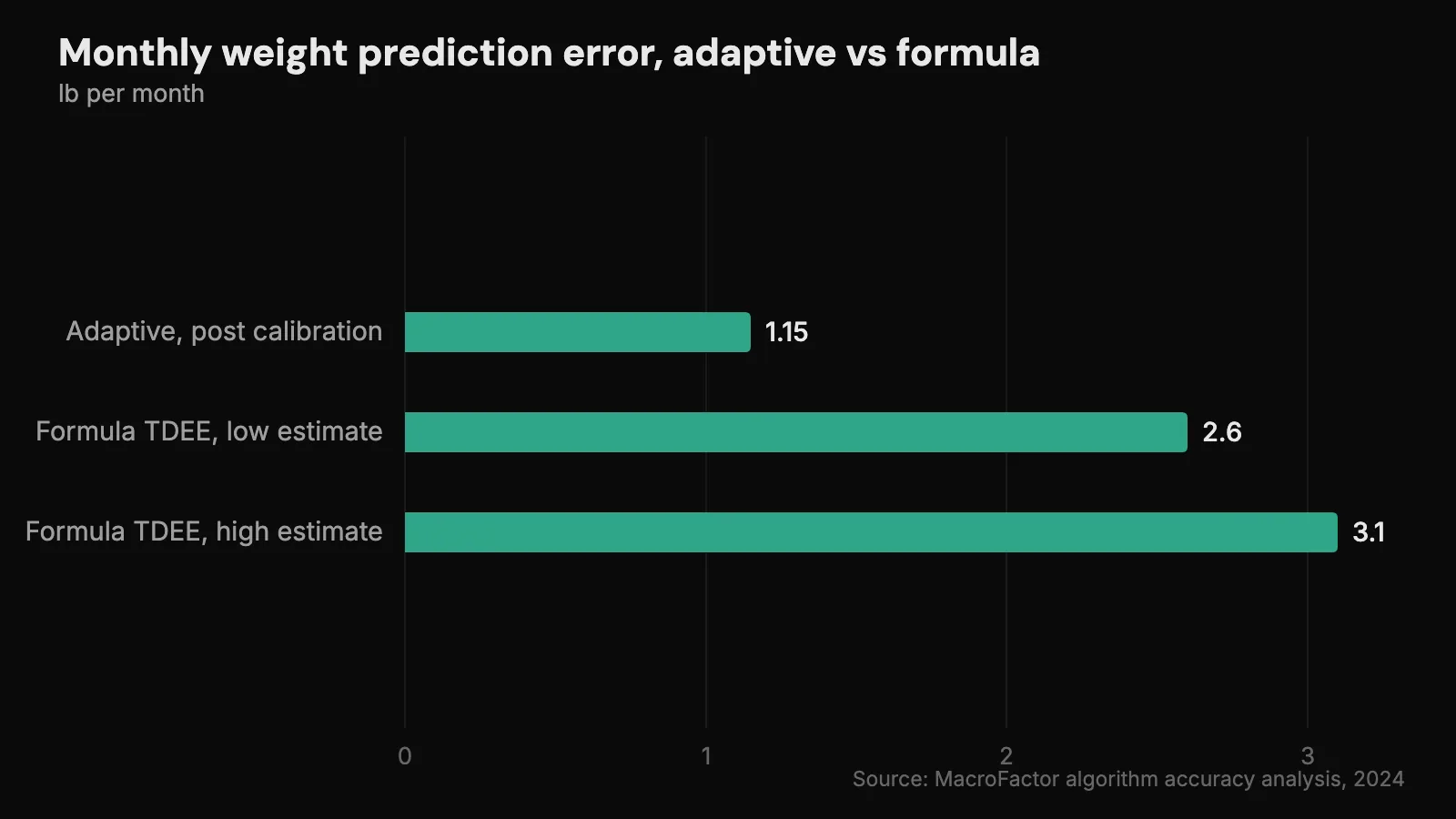
The error band comes from the vendor’s own dataset: about 4.4% of TDEE, near enough to 110 kcal a day, over a user’s first 100 days, tightening to about 3.25% or 80 kcal a day once the model has calibrated. Formula-based estimates missed monthly weight change by 2.6 to 3.1 lb against about 1.15 lb for the adaptive one. Adaptive won for 94.1% of users. The formula won for 5.9%.
The cost is cadence. Continuous updates need nutrition logged at least 6 of 7 days and weight at least once a week, which is the real adoption price of a target that moves by itself.
The model runs on weight trend and logged intake, and nothing else. No wearable calorie number. That’s the right call. A 2026 systematic review of 47 wrist-tracker studies found energy expenditure errors from 25% under to 38% over during aerobic running.
RESISTX also estimates expenditure from intake and weight. Its current estimator uses a fixed 7,700 kcal/kg conversion and displays a confidence band. Body-composition records provide another view of progress, but they do not currently adjust that conversion; DEXA vs InBody explains the limits of those measurements.
Does micronutrient depth matter if you are trying to build muscle?
For most lifters, no. Protein, total calories and consistency are what drive muscle growth, and a micronutrient panel you read once a quarter doesn’t justify daily logging friction. It matters if you’re deep in a long deficit, eating a restricted diet, or working with a clinician who wants intake data next to your bloods.
Cronometer’s depth is real, and RESISTX doesn’t match it. One caution before you use a nutrient count as the tiebreak: Cronometer’s own site says “up to 95” nutrients and compounds on one page and “up to 92” on its professional page, and the comparison posts quoting it cite older numbers again. Choose on workflow, not on the count.
The better question: does that log sit next to a bloodwork trend? A deficiency shows up in a blood panel over months, not in a week of logged micronutrients.
Which app has the better food database?
They optimise for different failure modes. Cronometer optimises for verified depth per entry, MacroFactor for speed and coverage. Neither difference is as large as the error you bring yourself: measured against doubly labelled water, participants under-reported intake by 25%, with 95% limits of agreement from 73% under to 68% over.
That error isn’t a side issue for an adaptive app. The expenditure model’s inputs are your weight trend and your logged intake, so database quality is upstream of algorithm quality, not a parallel category. A log that runs quietly 25% short doesn’t produce an obviously wrong expenditure number. It produces a plausible one that’s wrong.
Method changes the error more than app choice does. Diet records and 24-hour recalls under-report by 10 to 20%.
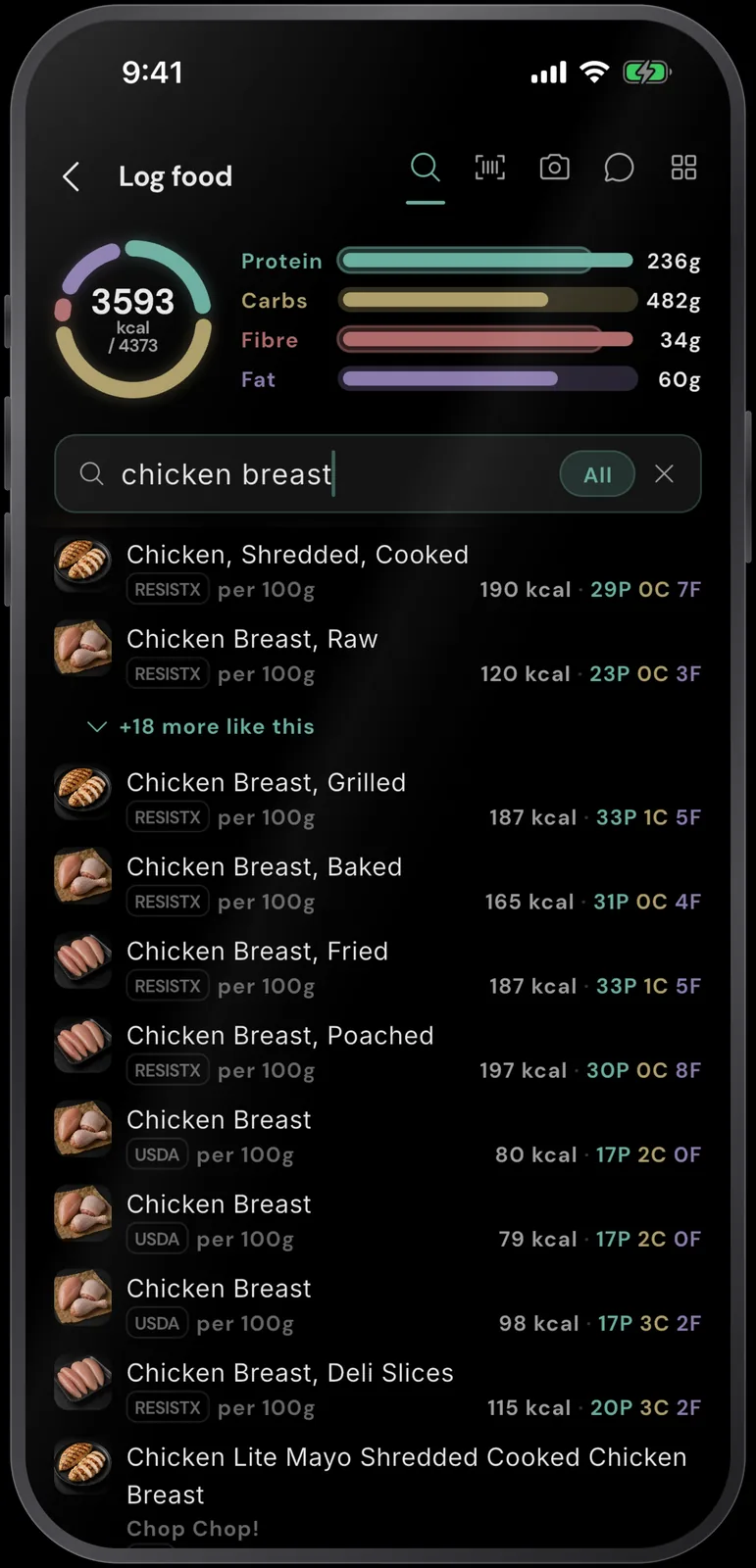
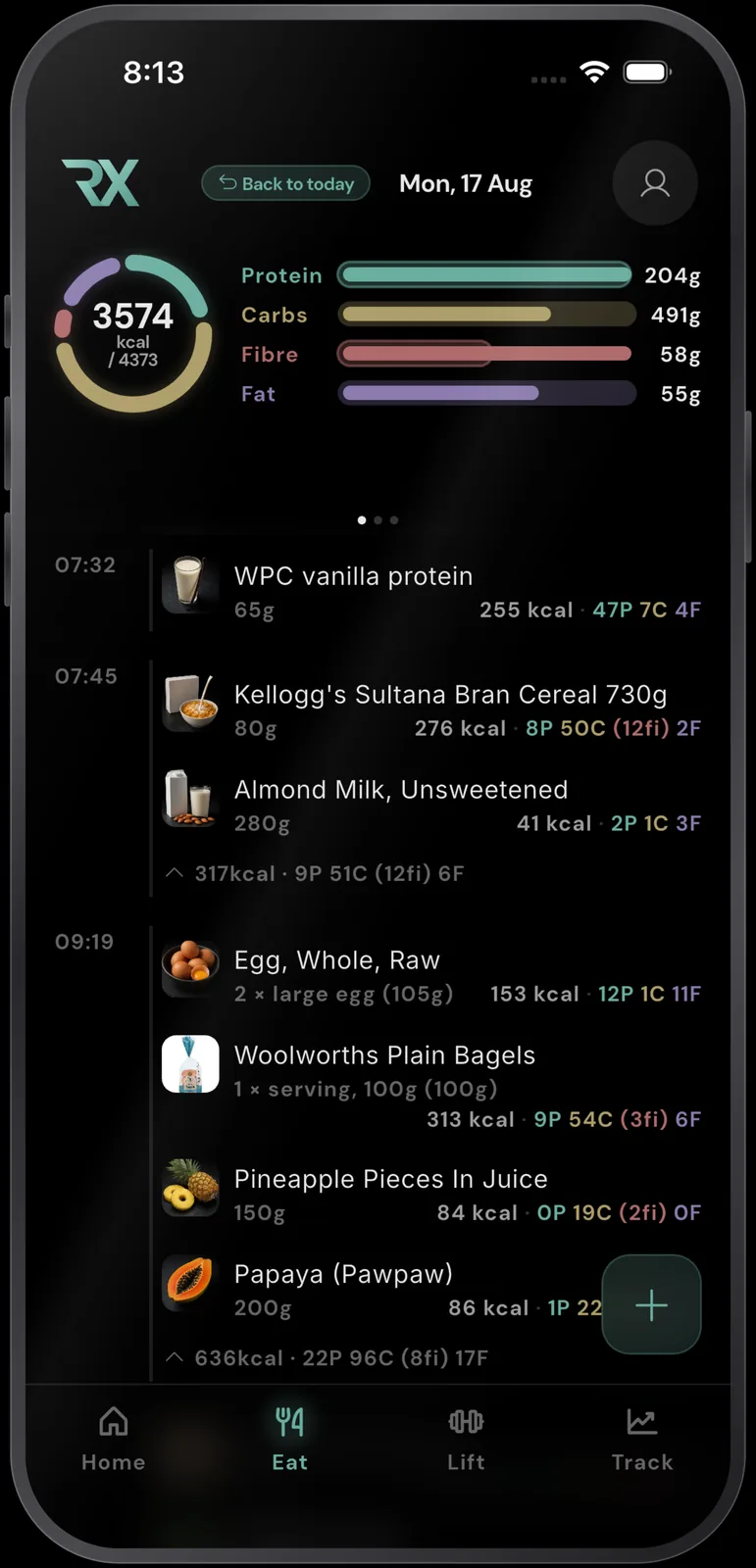
RESISTX handles the friction of that trade. Hundreds of hand-picked canonical staples rank first in search, with official regional sources behind generic foods (USDA, AFCD, CNF, CoFID) across AU, UK, CA and US. Five logging modes: search, barcode, photo of the plate, spoken meals, quick macro entry. Custom foods can be built from a photographed nutrition label. The whole database sits on-device, so search works in airplane mode.
Fibre is the one that quietly changes your totals. The US convention counts total carbs with fibre contributing 0 kcal, while the EU convention under Reg. 1169/2011 uses net carbs and 2 kcal per gram of fibre, so the same food returns two different daily totals. RESISTX makes that an explicit preference and treats the sum of each entry’s source-label kcal as the day’s authoritative number.
What happens to your calorie target when you switch from a bulk to a cut?
Your expenditure falls during a deficit, and it falls further than lost body mass predicts. It also persists: adaptive thermogenesis has been measured in people holding a reduced body weight for over a year. A maintenance number set from a formula after a cut reads too high.
An adaptive model catches that drift. A fixed target set in week 1 does not, which is why the number that worked in month 1 stalls you in month 3.
The trap is the phase transition itself. Glycogen and water move the scale 3 to 6 lb inside 1 to 2 weeks without changing fat mass, and any weight-driven algorithm misreads it. Starting creatine does the same. MacroFactor’s own write-up notes its pre-calibration estimate is goal-biased, so week 1 deserves scepticism regardless.
RESISTX filters incomplete food-logging days and reduces confidence as weight evidence ages. Water shifts still need interpretation: record the date of a phase change or creatine start and compare it with the weight trend before treating an expenditure change as metabolic.
How do MacroFactor and Cronometer compare to MyFitnessPal?
Most lifters arrive from MyFitnessPal, and the difference that matters is where its calorie target comes from. MyFitnessPal calculates your goal with the Mifflin-St Jeor formula, then adds or subtracts a flat 500 kcal a day for each pound of weekly change you asked for. That flat adjustment is the 3,500 kcal rule, the same static arithmetic Hall and Chow showed fails during a real diet. The target never reads your log: it changes only when you re-enter your stats, and the app offers a recalculation every 10 lb of recorded loss, which re-runs the same formula at a lower weight.
On logging speed the gap has closed: MyFitnessPal has photo logging (branded Meal Scan) and voice logging. If you’re moving off it, the question is the one this post is about: a target that recalculates itself, or a number you set and hold.
Switching has a real cost. An adaptive model needs 2 to 3 weeks of logging before its number means anything, so move at the start of a phase, not in week 6 of a cut. RESISTX cuts that cost: connect Apple Health or Health Connect and it imports up to 90 days of the daily calories and macros your previous app logged, plus your weight history if a smart scale has been recording it, so the expenditure model starts from your history, not from zero.
Where RESISTX fits
RESISTX is for lifters who want an adaptive expenditure model and a curated food database in the same app as their training, body composition and bloodwork. Expenditure is back-calculated from logged intake and the weight trend, with a projection, an uncertainty band, and goal-anchored targets for a bulk, a cut or a hold.
Body-fat fusion combines DEXA, skinfold and BIA estimates weighted by method reliability, with DEXA scans calibrating the cheaper methods, so composition sits beside nutrition instead of in a different app. Getting the scan into the app at all is its own question, and the short list of apps that import DEXA scans is shorter than most lifters expect. Training records add another view of progress. The numbers you use to track weekly volume sit alongside the day’s macros in RESISTX. MacroFactor’s training lives in a second, separate app.
I’m not a coach, and RESISTX isn’t one either. It doesn’t have the micronutrient depth of Cronometer, and MacroFactor’s expenditure algorithm is best in class.
Start your 14-day free trial on the RESISTX website, then download the app on iPhone or Android and sign in with the same account.
FAQ
Does Cronometer adjust your calories automatically?
No. It gives you the targets you set and shows where you sit against them. MacroFactor’s model recalculates the target itself from your weight trend and logged intake, taking 2 to 3 weeks to baseline and 1 to 2 weeks after that to register a real change. Treat the difference as a preference. Plenty of lifters want a number they control.
Can I use MacroFactor and Cronometer together?
Some lifters do: log daily in the faster app, spot-check micronutrients in the other every few weeks. Double-logging is something almost nobody sustains. A partial log is worse than a consistent one, because an adaptive estimate needs nutrition data 6 of 7 days to keep updating.
Do these apps work offline?
Partly. MacroFactor has a limited offline mode: it logs foods from your history and cached search results and syncs when you reconnect, but searching the full database needs a connection. Cronometer doesn’t offer one, and offline support has been an open feature request on its forums since 2017. RESISTX stores the whole food database on-device, so even search works in airplane mode.
Which app is better for a bulk or a cut?
Adaptive targets matter most across a long phase, because expenditure falls further than lost mass predicts and stays low afterwards. The catch is the first fortnight after a switch: glycogen and water shift the scale 3 to 6 lb with no change in fat, and a weight-driven model reads that as expenditure. Don’t act on an expenditure change in the 2 weeks after you flip goals.