Is bodybuilding good for longevity? Everyone's a bodybuilder
The week RESISTX went live in the App Store, I messaged Terry (name changed to protect the innocent), a retired acquaintance who had spent decades in the fitness industry, and invited him to try it. He was kind about it. The app looked great, he said, but in retirement his focus is longevity, and he isn’t chasing numbers in the gym anymore.
Fair enough, I thought. I built RESISTX, and the training log in Lift at its centre, for people like me: people who want as much muscle and as little fat as their bodies will allow, and who might one day stand on a stage. (I’m one of them, which is a polite way of saying I built it for myself.) A retired man looking after his health didn’t sound like that person.
Then I thought about it for longer, and I realised I had it backwards.
If you want to live a long time and stay capable while you do, building muscle is one of the best-supported things you can do about it. Building muscle and losing fat is all bodybuilding is.
RESISTX records what you choose to track. It does not give medical advice or dosing guidance, and neither does this article. Talk to your doctor about your own bloodwork or protocol.
Is bodybuilding good for longevity?
Yes, if you mean the part that builds muscle and strength, which is most of it. A meta-analysis of roughly 2 million apparently healthy adults found that people with higher grip strength had a 31% lower risk of dying during follow-up than people with lower grip strength (a hazard ratio of 0.69), and people with stronger legs had a 14% lower risk.
Strength comes in large part from muscle mass, and the same pattern shows up when researchers look at the training itself. Pooling 16 cohort studies, a 2022 review in the British Journal of Sports Medicine linked muscle-strengthening activity to a 10 to 17% lower risk of death from any cause, and of cardiovascular disease, cancer and diabetes.
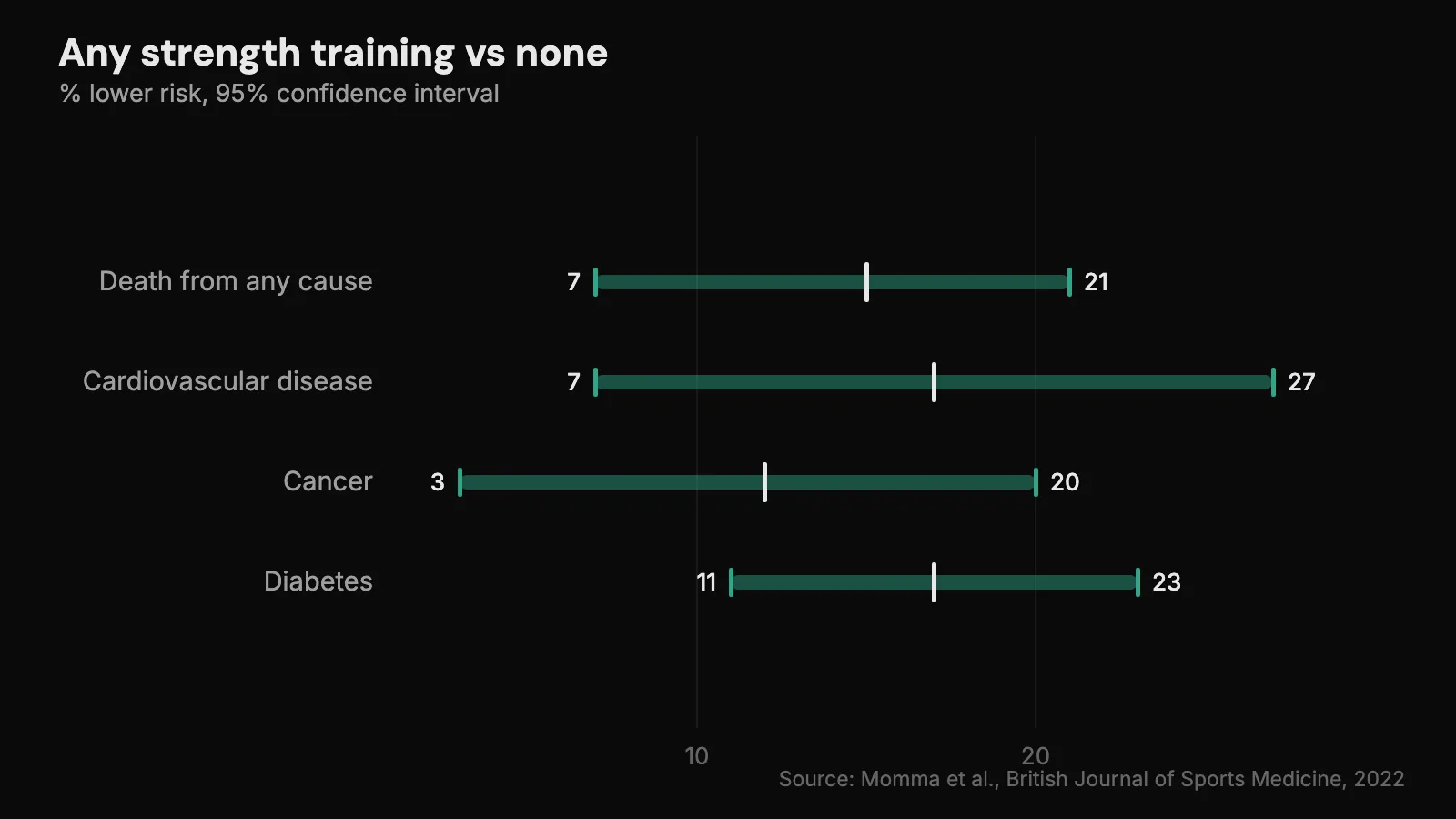
These are observational studies. They show that strong people tend to live longer, not that lifting alone is the reason, and the authors say so. Still, one review pooled 16 cohorts and the other covered around 2 million people, and both point the same way.
The more surprising number in that 2022 review is how little it takes.
How much strength training do you need for longevity?
About 30 to 60 minutes a week. In the same review the relationship was J-shaped: the largest drop in risk of death, roughly 10 to 20%, sat at 30 to 60 minutes of muscle-strengthening activity a week, and the authors were clear that the benefit of doing much more than that is unknown.
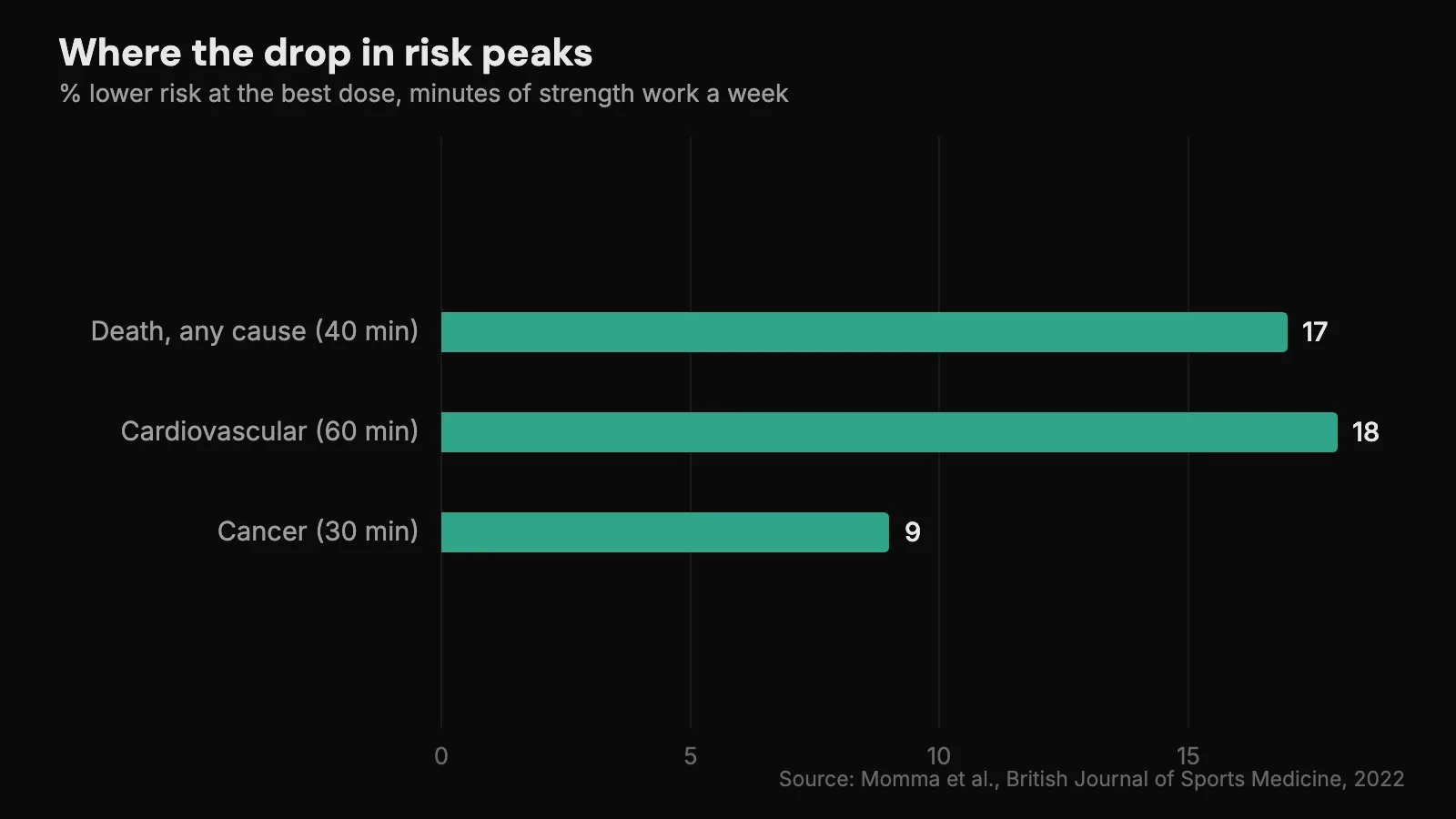
Do the arithmetic. That is 2 sessions of 25 minutes, or 3 of 20. (I train a lot more than that. That volume is for the stage, not for the actuarial tables.)
This should take some of the fear out of the word bodybuilding. You don’t have to get stage big to collect most of the benefit. You have to start, and then not stop. If you want to know whether the work you’re doing is enough to grow, the useful number is hard sets per muscle per week, and counting sets per muscle group properly is simpler than it looks.
The reason it matters so much later in life is what happens to people who don’t do it.
What happens to your body if you don’t build muscle?
The muscle goes, and the cost arrives as falls and broken bones. The age-related loss of muscle mass and strength has a name, sarcopenia, and a 2019 meta-analysis of 33 studies and 45,926 older adults found that people with it had 1.89 times the odds of falling and 1.71 times the odds of a fracture in the studies that followed people forward in time.
That is the part Terry cares about, whether he calls it bodybuilding or not. Living longer is only half of what people mean by longevity. The other half is still getting up off the floor on your own at 80.
Muscle is also one of the few parts of this you can measure directly. Scales guess at it, but a DEXA scan reports lean mass by region, and the error bars behind each method are in my comparison of DEXA, InBody and calipers.
I have a theory about this that I keep testing on friends.
Are you a bodybuilder if you only lift for health?
Yes, by the only definition that matters: you want more muscle and less fat. I’m not saying you want to compete, or diet down to stage condition, or stand under lights in a pair of trunks. I’m saying that if you go to the gym, or want to, the reason is almost always one of those two things.
Think about three people: a competitive bodybuilder, a dad trying to get back in shape, and an older woman who wants to be sure she doesn’t fall when she’s home alone. All three need the same three things. Training hard enough to give the muscle a reason to grow, enough food and protein to build it, and enough recovery to let it happen. Ask any elite bodybuilder what matters most and you will hear the same three.
Ten years ago I came to the view that resistance training is the least contraindicated intervention we have for improving quality of life. A teenager can do some version of it. So can a middle-aged dad, a grandmother, or someone in a wheelchair. The National Strength and Conditioning Association’s position statement on older adults makes the formal version of that case: properly designed and supervised resistance training is safe for healthy older adults and can reduce falls and fractures.
It’s a little funny that the activity with the vainest reputation in the gym turns out to be the one with the broadest reach outside it. (The aesthetics do matter. I won’t pretend otherwise.)
Knowing the three ingredients is the easy part. Doing them consistently, for years, is where most people stall.
Why track your training if you only want to stay healthy?
Because you can’t improve what you can’t see. If you have no record of what you did last month, you can’t honestly say you did better this month. You can only say it felt better, and feelings are a poor guide to a 2.5 kg change in a lift.
It’s easy to go to sleep on yourself. Stop paying attention for a few years, and you wake up a shadow of your former self, wondering what happened. What happened is that you took your eye off the things that mattered.
Every good coach I’ve trained under asked me a lot of questions. Even online coaches send a weekly check-in form with dozens of them. They ask because getting the most out of a human body takes context. A template plan can’t have any. The problem is that good coaching is expensive, and there aren’t enough good coaches for everyone who wants to get into better shape.
The other problem is that the context is scattered. I spent more than 20 years working in IT, and in any large company you learn that information split across separate systems loses most of its value. Fitness data has the same problem. I wear a ring that tracks my sleep and a watch that tracks my heart rate, and there are separate apps for training, food, medication and progress photos. Each one is good. Each one is a silo.
Where does RESISTX fit?
RESISTX puts that whole record in one place and lets you ask questions of it. You log every set and rep, and food by search, barcode, a photo of the plate or a spoken description. Weigh-ins, DEXA scans and blood test PDFs land on the same timeline as your training, and sleep, steps and heart rate sync in from Apple Health or Health Connect.
Once that record exists, you can open Ask RESISTX and type something like how do I improve my sleep, and it answers from your own logs rather than from an average person’s. It does the part of a coach’s job that depends on knowing what you did yesterday. The judgment about what to do next stays with you.
The first version I built, ten years ago, was a sets-and-reps logger with a one-rep-max calculator. It didn’t do much else. (It didn’t do much, full stop.) What changed over those ten years wasn’t the logging. It was understanding how much of the result depends on everything around the training: what you ate, how you slept, what your bloods were doing, and whether you were measuring any of it.
In launch week I recorded myself trying to explain RESISTX to people who will never step on a stage, and I didn’t know how to do it yet. Terry’s message helped me find the words.
If you want to live a long and capable life, you want muscle. Wanting muscle makes you a bodybuilder. Start with 30 minutes a week, and write down what you did.