Bloodwork for bodybuilders: what to test and how often
A natural lifter’s blood panel, read on its own, can look like 3 separate diseases. Liver enzymes up, kidney filtration down, testosterone at the bottom of the range: a clinician who knows nothing about you sees a liver problem, a kidney problem and hypogonadism. A lifter who trained legs 2 days ago, loads creatine and is 14 weeks into a cut is looking at the ordinary cost of those 3 choices.
That is the whole problem with bloodwork for bodybuilders. The panel is not special. The interpretation is. A single draw is a snapshot of your week, and the only way to tell your week from your health is to keep a run of results with the context attached, which is the job the bloodwork timeline in Track exists to do. This post walks through the 3 things you do that distort a panel, the reason a flag appears even when nothing is wrong, and the discipline that makes the next result comparable to the last one.
RESISTX records what you choose to track. It does not give medical advice or dosing guidance, and neither does this article. Talk to your doctor about your own bloodwork or protocol.
What blood tests should a natural lifter actually get?
The tests that answer a question you and the ordering clinician have actually asked, and nothing from a vendor’s “bodybuilder panel” that does not. A full blood count, liver and kidney markers or a lipid panel may each be relevant depending on symptoms, history and the reason for testing, and training alone does not create a need for any of them.
Low prevalence and high prevalence are both easy to overinterpret. Finding a deficiency in an athlete sample does not show that screening every lifter improves outcomes. The 2024 Endocrine Society vitamin D guideline advises against routine vitamin D testing in generally healthy adults without an established indication.
Record the question beside the date: fatigue during a cut, a previous abnormal result, follow-up of an existing condition. A small panel with a purpose attached is easier to read next time than a large one without. And whichever markers you land on, the 3 sections that follow are what your own habits will do to them before any disease gets a look in.
Why do my liver enzymes come back high if I lift?
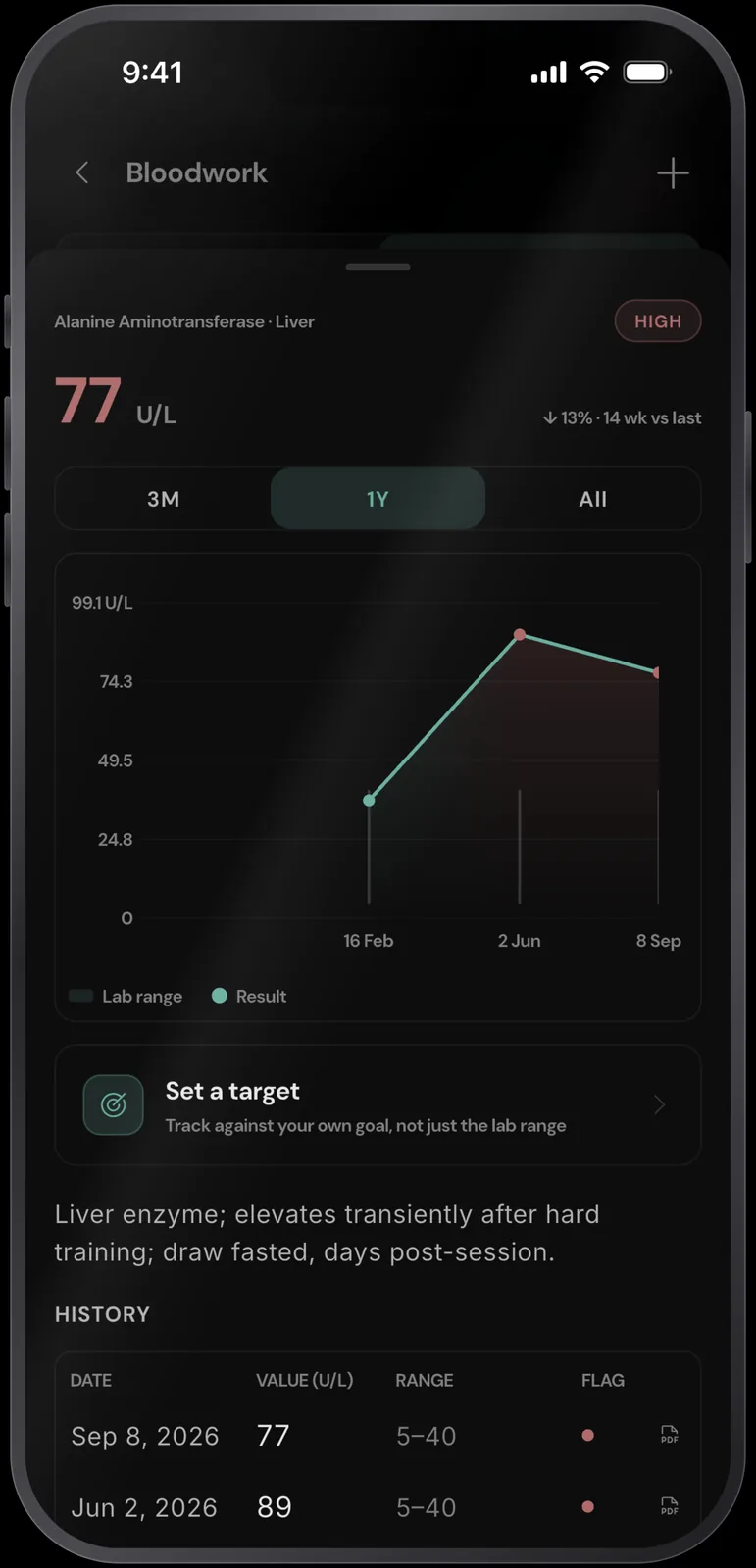
Because AST and ALT leak out of damaged skeletal muscle as well as out of the liver, and a hard session damages muscle. In a weightlifting study, men unaccustomed to lifting had increases in AST, ALT and CK that remained significant for at least 7 days after 1 session.
That was an unfamiliar workout, not a prediction for every trained lifter after every session, but the shape of it is the useful part. GGT, bilirubin and alkaline phosphatase stayed inside their normal ranges in the same men. A rise in transaminases with CK alongside and the biliary markers unmoved is the muscle pattern. It does not make a normal GGT a test that rules out liver disease, and it does not excuse ignoring a result that keeps climbing.
Tell the clinician when you last trained, what you did and how hard it was. Recording the session’s proximity to failure alongside the date makes that history specific. If a repeat is needed, agree on the preparation and timing instead of assuming every high result came from the gym.
Does creatine make my kidney results look bad?
It can, because creatinine is the breakdown product of creatine, and creatinine is the input to most eGFR calculations. Supplementing raises the input without touching the filtration the number is meant to estimate.
A 2025 meta-analysis found a small increase in creatinine and no statistically significant difference in GFR between supplemented and control groups. Muscle mass does the same thing with no supplement involved. The KDIGO 2024 kidney guideline names extreme exercise and bodybuilding as situations where non-GFR factors affect creatinine, and points to cystatin C, or an estimate using both markers, when a creatinine-based figure is hard to interpret.
Record creatine use, the dose and recent training, and hand them to whoever ordered the test. That is the second confounder a lifter carries into the lab. The meta-analysis does not tell you the cause of your low eGFR, so supplement use is context for the clinician, never a reason to dismiss the result yourself.
What does a cut do to a natural lifter’s bloodwork?
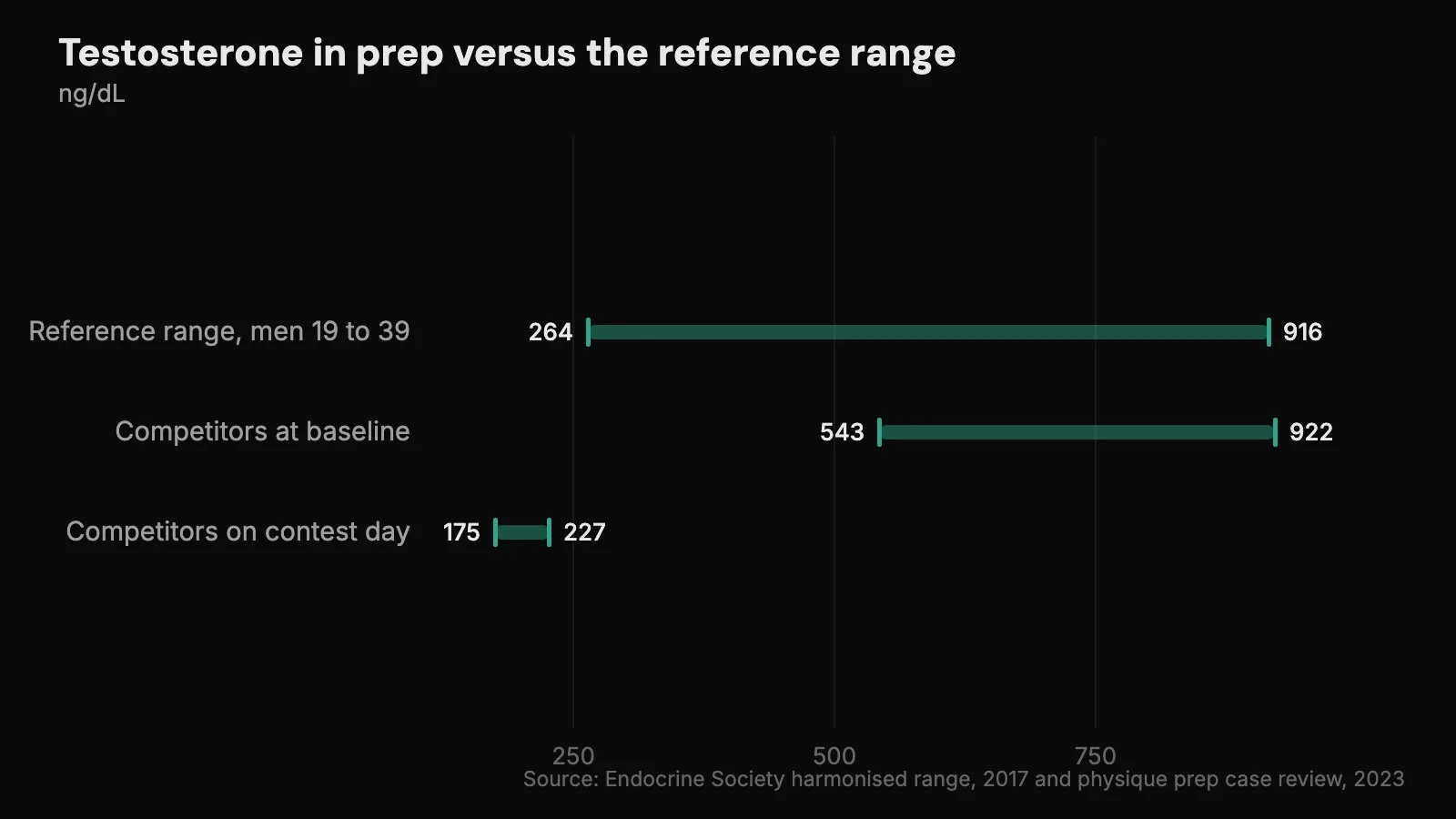
A long, hard cut suppresses testosterone and thyroid hormones with no drug involved, and a severe contest prep can push a drug-free man’s testosterone into the hypogonadal range by show day. This is the third confounder, and the one most likely to be read as a diagnosis.
Across a 2023 systematic review of 11 case studies covering 15 drug-free physique athletes (8 male, 7 female, preps running 14 to 32 weeks), total testosterone in the men started between 543 and 922 ng/dL and finished between 175 and 227 ng/dL on contest day. Cortisol rose in all 3 competitors in whom it was measured. For scale, the harmonised reference range for total testosterone in non-obese men aged 19 to 39 is 264 to 916 ng/dL, from 9,054 men across 4 cohorts. Contest day lands well below the bottom of it.
One drug-free bodybuilder tracked through 18 weeks of prep shows the shape of it. Free T3 fell from 4.3 to 2.7 pmol/L, into the clinically low range. Total testosterone went 14.4, then 9.1 at week 18, then 7.2 nmol/L at peak week. Resting energy expenditure dropped 519 kcal/day over the same window (REE ratio 0.99 down to 0.78) while body mass went from 81.8 to 76.7 kg.
Two limits worth stating. The evidence is case studies rather than trials, 15 athletes in total, with high inter-individual variability, so treat the group figures as a shape and not a forecast. And the diet phase explains the result without making it unimportant: recovery varies between individuals, and a value that stays low after the cut ends is a clinician’s question. Bring the prep history and symptoms to that conversation alongside the numbers.
Why can a blood panel come back with something flagged?
Because most reference intervals are built to flag 1 healthy person in 20 on every single marker, so a long panel on a healthy lifter will usually flag something. Many laboratory reference intervals use the central 95% of a reference population, cutting off the lowest 2.5% and highest 2.5%.
Some clinical thresholds are decision limits instead, so this is not a definition of every boundary printed on a report. But run the arithmetic on the 95% kind: for 20 independent tests, each with a 5% chance of falling outside its interval, the chance of at least 1 flag is 1 minus 0.95 to the power of 20, or 64.2%. Real blood markers are correlated, so that is an illustration of multiple testing, not a measured flag rate. It is still the reason a flag on its own establishes nothing.
Stack this on top of the 3 confounders above and the average lifter’s panel has 4 reasons to show a flag before any disease is on the list. A flag is a prompt for 3 questions. How far outside the range is it. Is it moving in 1 direction across draws. Is there a known confound sitting on it: training, creatine, hydration, time of day or diet phase.
| Flagged on the report | Possible interpretation | What a lifter checks first |
|---|---|---|
| AST and ALT high | Liver stress | Days since the last hard session, plus GGT and CK on the same draw |
| CK several times the ceiling | Muscle damage, possible rhabdomyolysis | Recent exercise, symptoms, the size of the rise and the clinician’s assessment |
| Creatinine up, eGFR down | Reduced filtration | Creatine use and muscle mass; cystatin C is not produced by muscle |
| Total testosterone low | Hypogonadism | Whether the draw was fasting and morning, and whether a cut was running |
Every row in that table ends the same way: the answer is in the draws around this one, not in this one.
How often should lifters get bloodwork done?
As often as the reason for testing demands and no more, but under conditions consistent enough that the second draw can be compared with the first. Frequency is the wrong question for a self-coached lifter. Comparability is the right one.
The interval itself follows the clinical question. Monitoring an existing condition runs on a different schedule from screening a healthy person, so ask whoever orders the panel which result needs repeating, when, and under what conditions. Testosterone shows why repetition is built into the rules: the Endocrine Society guideline diagnoses hypogonadism from compatible symptoms plus consistently low concentrations, confirmed with a repeat fasting morning measurement, and reports that about 30% of men with an initially low result read normal on repeat.
Consistency is what makes a repeat worth anything. Same lab, same assay, same time of day, same rest since the last hard session. Between-lab and between-assay differences can be bigger than the change you are trying to see, and a trend assembled from 4 providers partly measures the providers. Body composition has the same floor, where least significant change on DEXA decides whether a scan moved at all.
Testosterone has a published version of that floor. Week-to-week biological variation in healthy men came out at 10.2% when 38 of them gave weekly samples for 10 weeks, with study-specific reference change values of about a 27% rise or a 21% fall before 2 draws differ by more than noise. Those values describe variation under the study’s conditions. They are not a rule for dismissing a smaller change, particularly when symptoms or an abnormal absolute value are present.
How do you keep years of lab PDFs in one place?
Import them into a single dated record, so that every result sits beside the training, supplements and diet phase that were running when the blood was drawn. Lab reports arrive as PDFs from different providers in different units, and a folder of them cannot answer the question this whole post has been building to: is this marker moving, or is my week moving it?
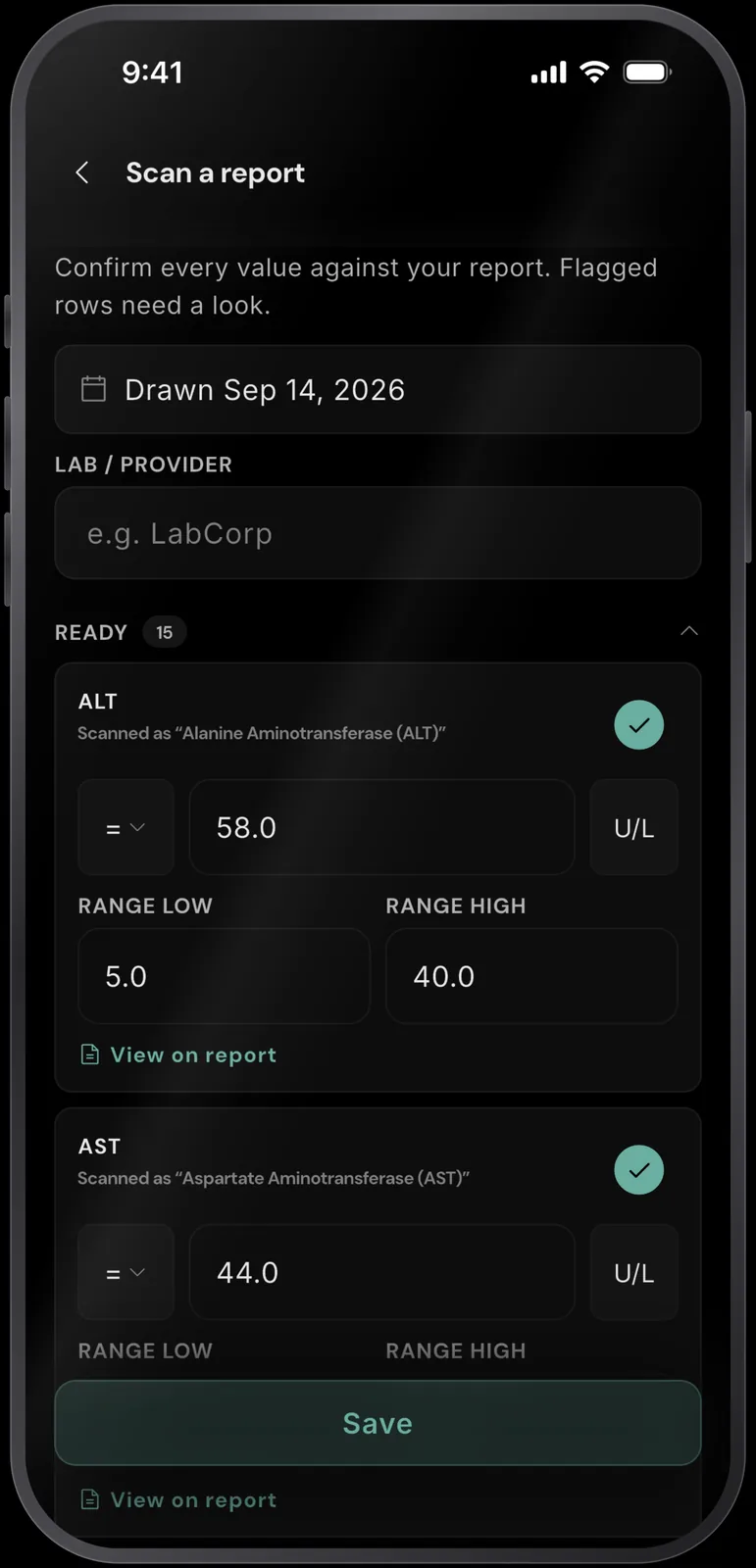
RESISTX imports bloodwork from lab PDFs, matches markers against a 166-analyte catalogue, reconciles units between labs, and keeps every value traceable back to its source page. Individual markers get trend views, and Track puts blood panels on the same timeline as training and protocol records, so the 7-day transaminase tail, the creatine start and the week-16 testosterone all sit next to the sessions and phases that explain them. AI does the capture and nothing else: reading the PDF, matching the marker, pulling the unit. RESISTX tracks labs you already get, from any provider, and does not order or sell tests. It records what you choose to track and gives no medical advice or dosing guidance.
Before the next draw, write down 3 things and repeat them every time after that: which lab, what time of day, and how many days since your last hard session. Without those, the second result is not comparable to the first, and everything above stays a snapshot.
FAQ
How long should I rest before a blood test?
Tell the clinician about your recent training and ask what preparation the specific tests require. Exercise can affect AST, ALT and CK for days; the weightlifting study above found elevations for at least 7 days. That does not establish 1 rest period for every panel, and you should not delay an urgent test to obtain a rested baseline.
Do I need to fast before a blood panel?
Follow the instructions for the tests ordered. The EAS and EFLM lipid consensus says routine lipid profiles generally do not require fasting, although a fasting repeat may be appropriate in some circumstances. Testosterone assessment uses fasting morning samples. If your panel combines several tests, confirm the preparation with the ordering clinician or laboratory.
Should I stop taking creatine before a blood test?
Tell the clinician that you use creatine and ask how to prepare for the tests ordered. Supplementation can affect serum creatinine, which can alter a creatinine-based eGFR. Whether to repeat the test, use another filtration marker, or change preparation depends on the clinical question. A low eGFR should not be dismissed on the basis of creatine use alone.
Does low testosterone during a cut mean hypogonadism?
Severe contest preparation can coincide with low testosterone, but the diet history does not establish a diagnosis or make the result harmless. Diagnosis requires the clinical picture and repeat testing, as described above. Take persistent symptoms or low results to a clinician and bring the timing of the cut, training and blood draws.
Why is my CK high after training?
CK can rise after muscle-damaging exercise, so recent training belongs in the interpretation. It helps to track sets per muscle group and the session dates. The cause of an individual result still needs assessment. New muscle pain, dark urine or a large unexplained rise calls for prompt medical attention, rather than assuming that training explains it.