What is adaptive TDEE, and where does it break down?

A TDEE calculator asks for your height, weight, age and an activity multiplier, then hands back a calorie estimate. Adaptive TDEE runs the other way. It takes your logged food and your weight trend and works maintenance backwards from those 2 inputs. That is why it needs the smoothed weight trend in Track.
The estimate can follow you through a cut or a bulk instead of leaving you with the number you started on. It also inherits errors from both inputs. A missing dinner and a kilogram of water can move the answer even when your expenditure has stayed the same.
What is adaptive TDEE?
Adaptive TDEE is an estimate of your total daily energy expenditure, worked backwards from food intake and weight change. If your weight trend is falling, the model adds an estimate of the energy coming from body stores to your logged intake. If it is rising, the model subtracts the estimated energy being stored.
A formula calculator starts elsewhere. Mifflin-St Jeor predicts resting energy expenditure from body size, age and sex; an activity multiplier is then used to estimate the whole day. The original Mifflin study developed its resting-energy equation in 498 healthy adults. Accuracy at predicting rest is a different question from accuracy at predicting your full day of work, training and movement.
Adaptive estimation replaces that starting prediction with evidence from your own records. The trade-off is that the food log and weight trend have to represent what actually happened.
How does an adaptive TDEE calculator actually work?
The core calculation is intake minus the estimated change in stored energy. Weight loss makes that second term negative, so expenditure comes out higher than intake. Weight gain does the reverse.
Here is a worked example, using an assumed energy density of 7,700 kcal/kg. These are illustrative numbers, not a person’s measured results.
| Input or calculation | Value |
|---|---|
| Average logged intake | 2,500 kcal/day |
| Weight-trend change | Losing 0.35 kg/week |
| Estimated energy drawn from stores | 0.35 × 7,700 ÷ 7 = 385 kcal/day |
| Estimated expenditure | 2,500 + 385 = 2,885 kcal/day |
If the trend instead rose by 0.35 kg/week, the same assumptions would give 2,500 minus 385, or 2,115 kcal/day. If it stayed flat, the model would estimate 2,500 kcal/day. The assumption matters. A different energy density would change both moving-weight examples.
RESISTX smooths weight and intake before making this calculation, then smooths the expenditure estimate too. The current estimator uses 7,700 kcal/kg. That is a modelling assumption, not a claim that every kilogram your body gains or loses contains that much energy.
Smoothing reduces short-term movement but introduces lag. A 14-day simple average gives equal weight to readings from today through 13 days ago; their average age is 6.5 days. An exponential average gives recent readings more weight, with its responsiveness set by the chosen half-life. Neither method can determine from weight alone whether a change was fat, lean tissue or water.
I weigh at night, just before bed, because it is the routine I can repeat. Keep the scale and conditions consistent. Repeatability comes first.
How long does adaptive TDEE take to become accurate?
Expect the estimate to develop over several weeks of consistent logging. MacroFactor describes about 2 to 3 weeks to establish an initial estimate, and 3 to 4 weeks to refine it. Those are its product guidelines, not a universal accuracy deadline.
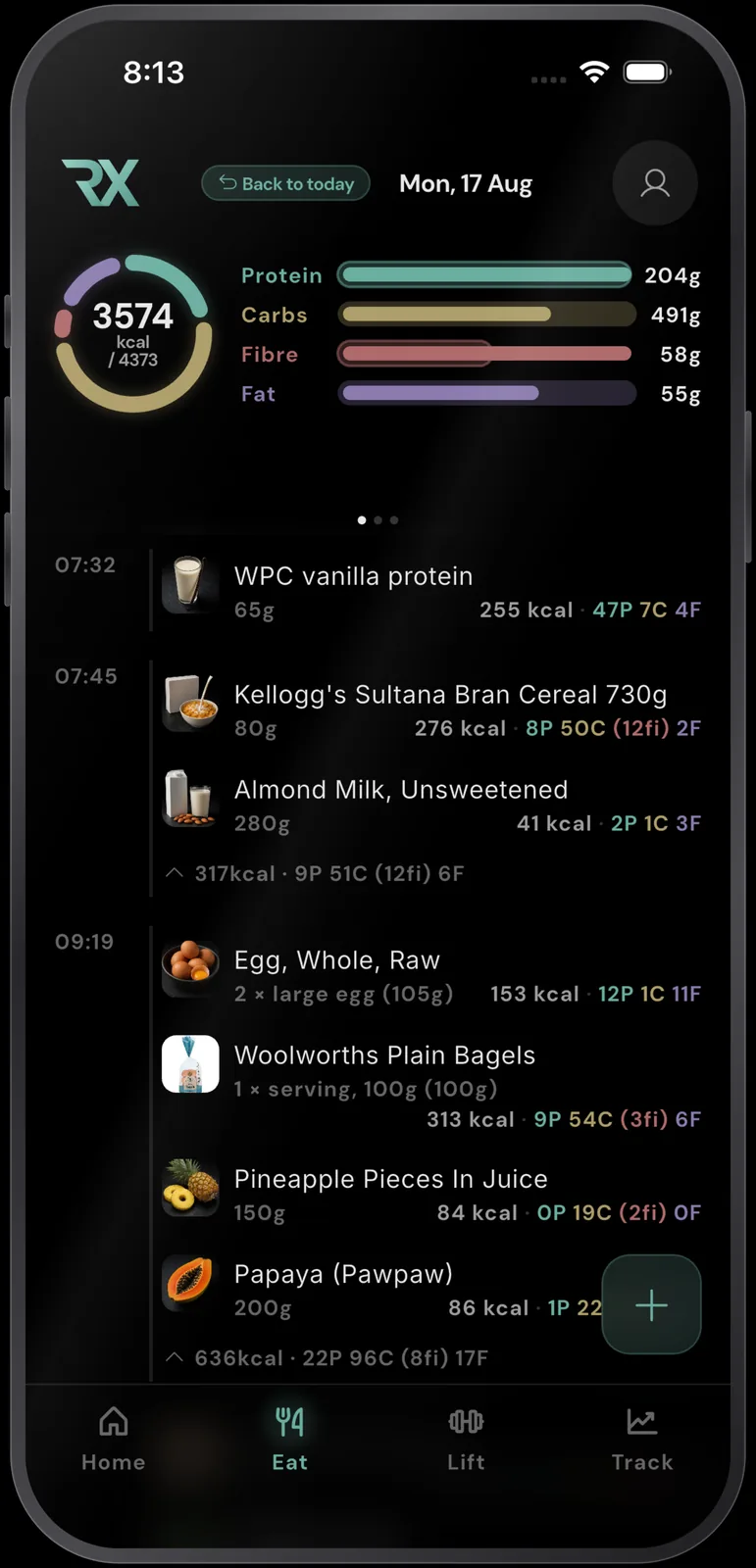
RESISTX counts days that pass its food-log completeness checks. Its calibration label changes at 7 and 21 complete days, and it also needs a usable weight trend. Missing days stretch the calendar. A complete-day check can catch some gaps; it cannot prove you recorded every calorie.
Early changes may reflect the starting formula being corrected as your records accumulate. A moving estimate is not, by itself, evidence of a sudden metabolic change. Before adjusting a target because the estimate moved, check the logging history and the weight trend behind it.
Why is my adaptive TDEE wrong?
Two important failure cases are unrecorded food and weight changes that are not changes in energy stores. Both interfere with the calculation, but waiting does not solve them in the same way.
In the worked example, suppose the log missed 300 kcal every day. Actual intake would be 2,800 kcal, and the same weight trend would imply expenditure of 3,185 kcal/day under the same model. The incomplete log would keep the estimate 300 kcal/day low. Another fortnight of the same logging would preserve that error.
RESISTX excludes days it classifies as incomplete from its intake average. That reduces one route to a bad estimate, but a day can pass those checks and still omit a snack, cooking oil or a drink. Check the log first. The algorithm cannot discover an unlogged meal.
Water is a different problem. In a creatine supplementation experiment, body water increased during supplementation. That can add scale weight without representing the tissue gain assumed by the energy calculation. Carbohydrate changes can also move glycogen and its associated water; the glycogen and hydration review explains why the water response varies with the conditions.
A cut-to-bulk switch can therefore make early gain look larger than the tissue gain underneath it. The reverse switch can make early loss look larger. A smoothing filter reduces brief fluctuations, but a sustained step in water weight can still enter the trend.
There is no single recovery window for every app and every water shift. Keep logging through the change, note its date, and check whether the trend is settling before treating a short-term expenditure move as a reason to change your intake.
Why didn’t my expenditure go up when I started training more?
Training more does not guarantee the weight change you predicted. In the E-MECHANIC randomised trial, adults assigned to exercise lost less weight than predicted, with increased intake contributing to compensation. The calorie cost of a session and the resulting change in your daily energy balance are different quantities.
You may also change how much you move outside training. What the adaptive estimate eventually reflects is the combined result of intake and expenditure in the weight trend, subject to the model’s assumptions. It cannot isolate the cause.
If you add 4 sets per muscle, judge the training change using performance and recovery as well as the calorie estimate. The volume landmark framework gives you a way to organise that decision. A flat expenditure line does not tell you whether the extra sets were productive.
Adaptive TDEE vs a calculator vs your watch: which number should you use?
Use a formula to establish a starting estimate. Once you have consistent intake and weight records, use the adaptive estimate alongside the observed trend to review that starting point. A watch gives you another estimate with different inputs; it is not an extra allowance to add to adaptive expenditure.
| Method | Inputs | Useful role | Main limitation |
|---|---|---|---|
| Formula TDEE | Body size, age, sex and an activity multiplier | Starting estimate before logging | Population prediction and a coarse activity assumption |
| Adaptive TDEE | Logged intake and weight trend | Updating estimated maintenance as records accumulate | Missing food, water changes and tissue-energy assumptions |
| Wearable estimate | Device sensor data and its algorithm | A separate estimate of expenditure | Accuracy depends on the device, activity and person |
A validation study of 7 wrist-worn devices found that none achieved energy-expenditure error below 20% across its study conditions. Those were the devices tested in 2017; the result is not an error estimate for every current watch. It does show why heart-rate accuracy cannot be taken as evidence of calorie accuracy.
If an adaptive estimate already includes the effect of your training on energy balance, adding a watch’s exercise calories double-counts that contribution. Use one target-setting method. Then judge it against your subsequent records.
What can body composition tell you that weight alone cannot?
Weight change can contain different proportions of fat and lean tissue, which have different energy contents. A flat scale can hide recomposition. That limits any calculation that converts weight movement into energy using one assumed value.
MacroFactor discusses these assumptions openly in its expenditure algorithm explanation. Its account covers fat and lean tissue, the effects of modelling weight gain differently from loss, and a change made in V3 to reduce bias from weight fluctuations.
RESISTX’s current TDEE calculation uses the fixed 7,700 kcal/kg assumption described above. Body-composition measurements provide another view of progress, with their own uncertainty; the body-fat method comparison explains those error bars. They do not currently replace that conversion in the expenditure estimator. Blood markers offer a third view of what months in a deficit actually cost you, and what a cut does to testosterone is one thing neither the scale nor the expenditure estimate can show you.
RESISTX shows the expenditure estimate with a confidence band. Its adaptive calorie targets use a weekly snapshot of that estimate, so the target can follow maintenance without changing with every daily movement in the display. You set the goal.
Before acting on a change, read the food log and weight trend for the same dates. Fix missing meals, mark major changes in your routine, and compare what happened after the last target adjustment.
Questions people ask
Does creatine affect adaptive TDEE?
It can. An increase in body water can raise scale weight without the tissue gain the calculation assumes, temporarily pulling estimated expenditure down. The effect depends on the weight response and the algorithm. Keep recording intake and weight, note when supplementation changed, and avoid interpreting that initial scale movement as a direct measure of fat gain.
Is adaptive TDEE better than a formula calculator?
It can provide a more useful estimate for adjusting your targets because it incorporates your own intake and weight history. A formula remains useful before that history exists. The adaptive result still depends on logging quality and the assumptions used to turn weight change into energy; calibration does not make those limitations disappear.
Do I have to weigh myself every day?
Daily readings give the model more observations, but repeatable conditions matter too. Pick a routine you can maintain with the same scale. RESISTX can retain an estimate through missing weigh-ins, while older weight evidence reduces confidence. If your routine changes, record that alongside the readings so you can interpret a shift in the trend.
Why did my adaptive TDEE go down when I started eating more?
A sustained water increase can make the model infer more energy storage from your weight gain. Extra food omitted from the log can also lower the estimate relative to your actual expenditure. These require different responses: let a temporary water shift settle, but correct incomplete logging. Repeated omissions do not resolve simply because another 2 weeks pass.